I had always thought of the Atacama Desert as a mystical and remote place. This strange corner of the Earth attracts many superlatives. It may have been a desert for 200 million years – almost half the period that animal life has existed on Earth. There are places in the Atacama that have never had recorded rainfall, while others have remained rainless since the medieval age. Aside from the poles, it is the driest place on Earth. What looks like snow on the high mountain tops is, in fact, salt, sublimated from countless centuries, where a tiny amount of moisture condenses, bringing minerals from the desert floor. One might have thought that a desert cannot be interesting, but the Atacama is a strange place, with a clear-aired beauty that bewitches the traveler.
So, when we arrived at San Pedro de Atacama, a few hours east of Calama, I was prepared to see no roads at all, or inhabited towns or villages. But I was surprised. San Pedro de Atacama is a little island, floating in a dusty desert, punctuated by salt flats, red sandstone, and dunes heaped up by the restless wind. It is an unlikely place, built around an oasis surrounded by trees, visible from the heights around it, on a flat plain, the Puna de Atacama.
Across from our villa, constructed, no doubt at great expense, from blocks of thick adobe, there is an Andalusian donkey, tied down for the whole day. He lets out the occasional loud and prolonged bray. Perhaps he is wondering what business we have in his homeland. But we are sightseers. The land does not afford much of a life to humans, and the native peoples, the Atacamenos (native being a relative term; humans only arrived in the southern hemisphere via Beringia 11,000 years ago), eked out only a slender living. So tourism has become this land’s business. Now, the town caters to a different kind of clientele, with oddly dissonant restaurants serving Italian cuisine, coffee, and gelato, like a little foreign bit of Kathmandu that was displaced and deposited here.
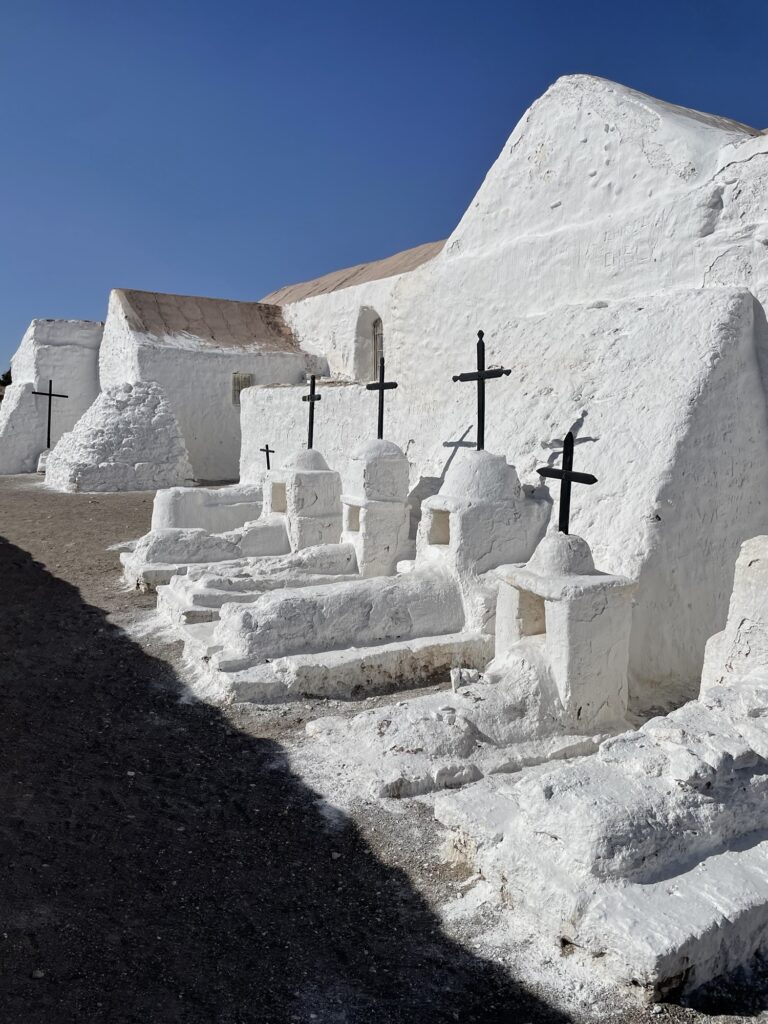
A small white cathedral, beautiful and old from 1537, sits in a small plaza in the center of town. One of my traveling companions wondered why the Spanish would build a cathedral in this forgotten part of Chile. But it is a relic of the Spanish quest to convert the “heathen” to a more enlightened form of religion (their own, naturally) as part of colonization. On second thought, I have it backwards: to colonize, they used the force of religion to deracinate and dismember the ancient tribes that roamed over this country. I don’t mean to sound cynical – the Incas, after all, came and swept over the Atacameno tribes, the most ancient of the peoples here.
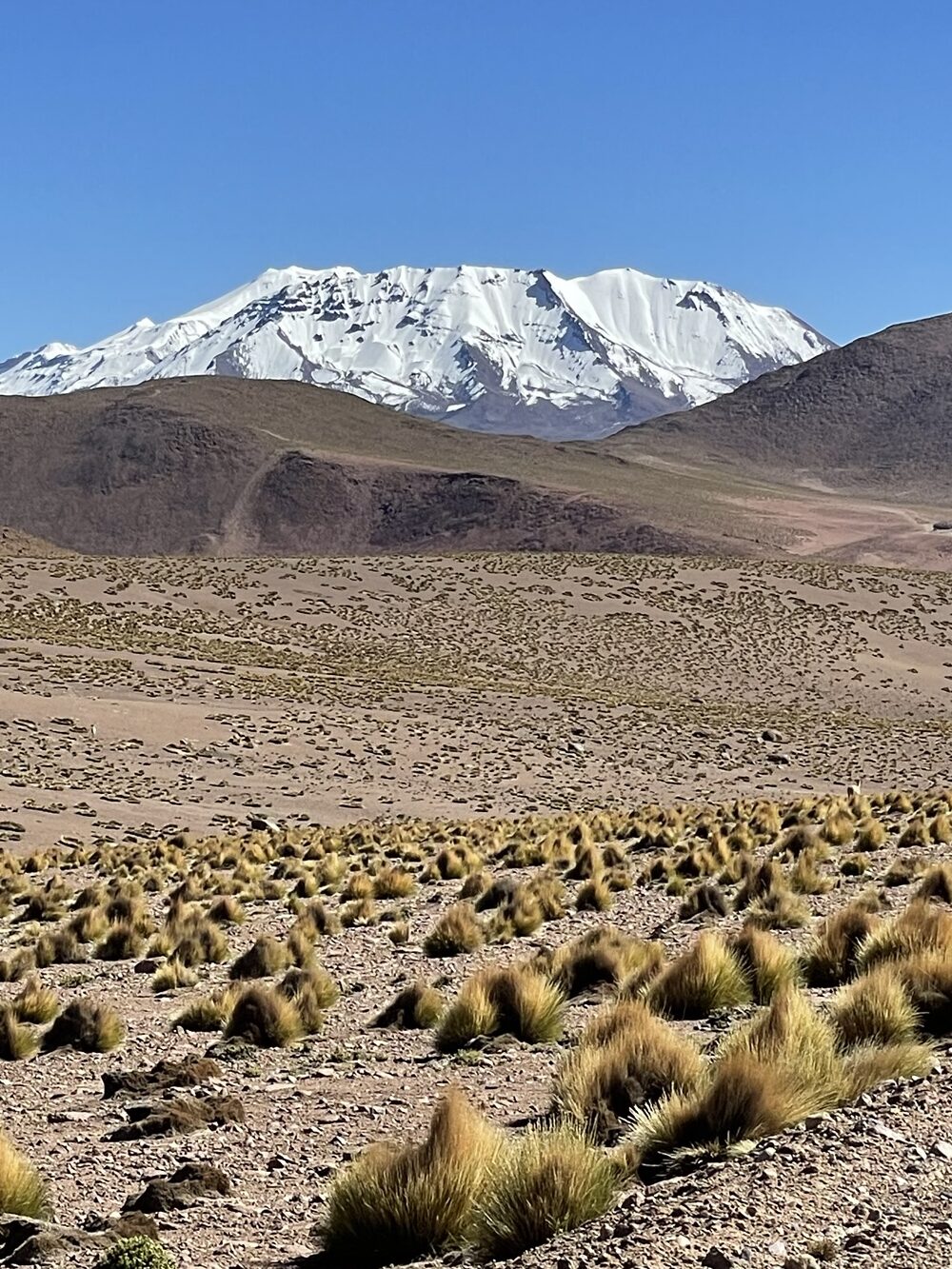
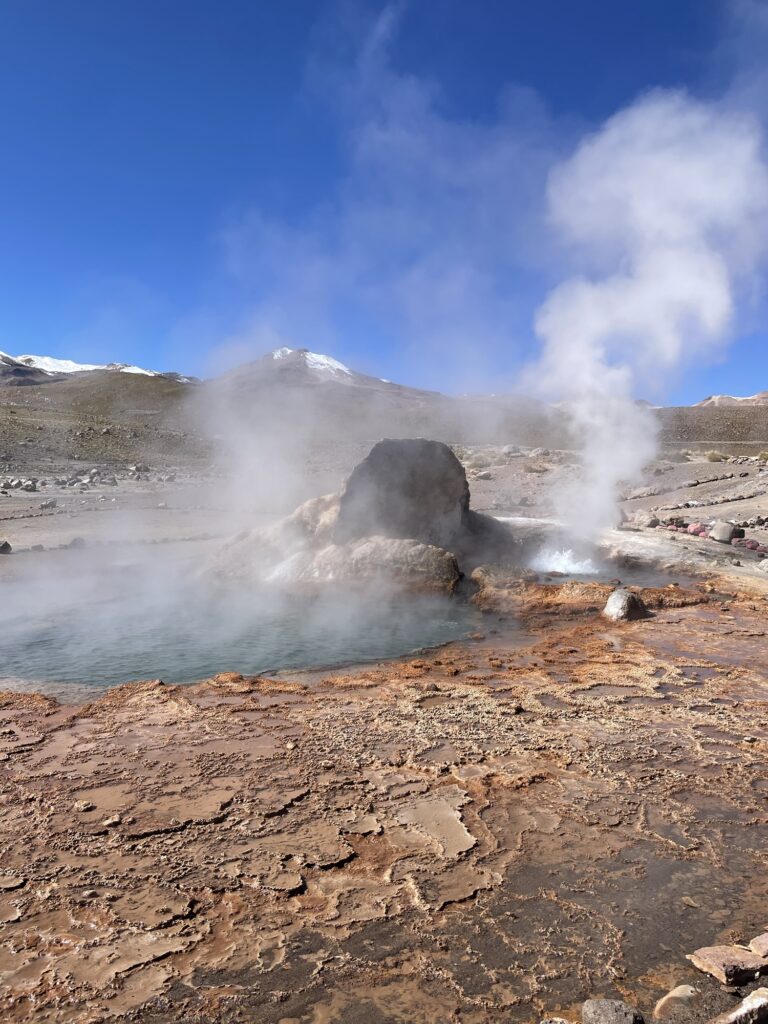
Surrounding San Pedro, there are a number of remarkable reserves, run by the aboriginals of the area. The most spectacular is surely the Geysers of Tatio. These sit on a high plateau, almost 3 hours above the San Pedro valley, along a dirt road. The road would be impassable if this were not one of the driest spots on Earth – certainly in many parts of the world, continual washouts would occur. But instead, it is merely torturous with its washboard roadbed rattling both truck and passenger, numbing the steering hands as we slowly make our way up it. However, the traveler is well compensated by views which are like multilayer paintings: the red sandstone with pampas grass, yellow and light green, like feathers, against a palette of red, dusty sandstone, and a distant backdrop of pyramidal snow-capped volcanoes. Here and there, a gully appears, full of lush vegetation, like a small jungle transported to this arid space.
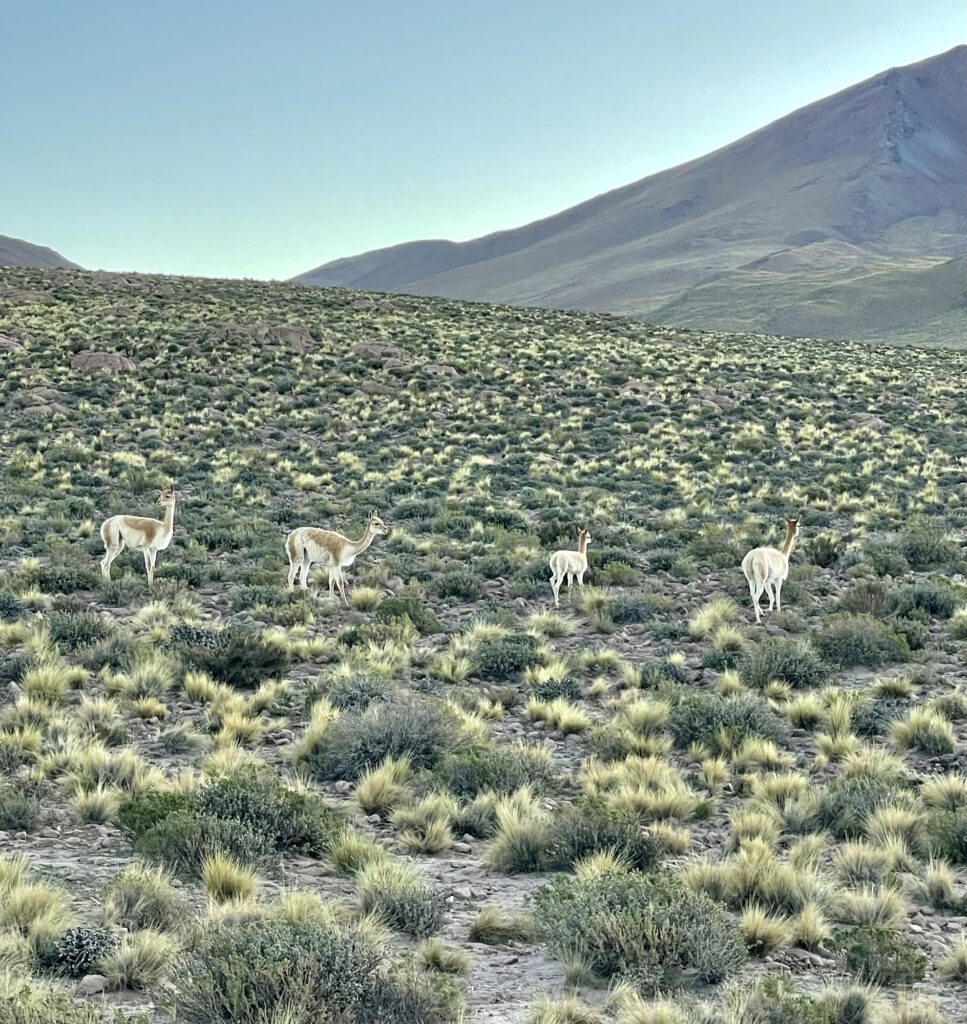
The geysers themselves sit like a family, content to settle in the valley, surrounded by volcanoes, each sending its white, vapory silhouette into the sky before the breeze dissipates it. Here and there, boiling water bubbles up in rock bowls, like a witch’s cauldron. Vicuñas and guanacos, deerlike creatures, wander with their families through the boiling hot steam of the geysers, seemingly unconcerned.
On the way back down, we stopped in Machuca for a delightful lunch of freshly fried, crispy empanadas filled with the local stringy white cheese, along with Nescafe instant coffee with milk and sugar. We enjoyed it all while sitting on the dusty terrace, surveying the old white church, the wide dusty plain, the distant mountains, and the winding road below.